
Android → iPhone
Send files from Android to iPhone
For years the honest answer was an app on both phones or a round trip through the cloud. 2026 added three built-in shortcuts: some Android phones now appear in the iPhone's AirDrop list, any Pixel or Galaxy can hand an iPhone a Quick Share QR code, and Android 17 can move a whole phone's worth of data to a new iPhone without the Move to iOS app. Each has a boundary worth knowing before you try it. Below are the eight routes that actually work, where each one stops, where the files end up on the iPhone, and how BIShare covers every Android phone and every iPhone, in the same room or not. Free, open source, and no one signs up.
BIShare is ours. Three routes on this page come with the phones at no charge, and for a quick photo to a nearby iPhone they may be all you need; the sections say so where that is the case.
Quick answer
- Your Android is a Pixel 8a or newer, or a recent Galaxy: open Quick Share and pick the iPhone once its AirDrop is set to Everyone for 10 minutes. Photos drop straight into the iPhone's Photos app.
- The iPhone isn't showing up, or it isn't nearby: on a Pixel or Galaxy, tap Use QR code in Quick Share. The iPhone scans it with the Camera and downloads in Safari, up to 10 GB per 24 hours.
- Any Android phone at all, same Wi-Fi: install BIShare on each and the untouched originals cross the Wi-Fi, encrypted, however large they are.
- Many gigabytes to someone far away: make a BIShare link; it takes 100 GB, and the iPhone needs only Safari to collect it.
- Setting up a new iPhone: use Apple's transfer during setup. Android 17 does it without an app; older Android needs Move to iOS. A USB-C cable between the phones speeds it up.
- Before a big download in Safari: check Settings, Apps, Safari, Downloads. By default files go to iCloud Drive and count against your iCloud storage.
Three shortcuts that arrived in 2026
Apple and Google both moved in the past year, and the result is more built-in options for Android to iPhone than there have ever been. None of them is universal, so the useful question is which one your two phones qualify for.
Quick Share can target AirDrop
Google's help page lists the Pixel 8a and later, plus certain Samsung, Oppo, OnePlus, Vivo, Xiaomi, Honor, Transsion and Motorola models. On those phones the iPhone appears in the Quick Share sheet as long as its AirDrop is set to Everyone for 10 minutes. On a Galaxy, Share with Apple devices must also be on in Quick Share settings. Both phones need Bluetooth and Wi-Fi and have to be close.
A QR code for any iPhone
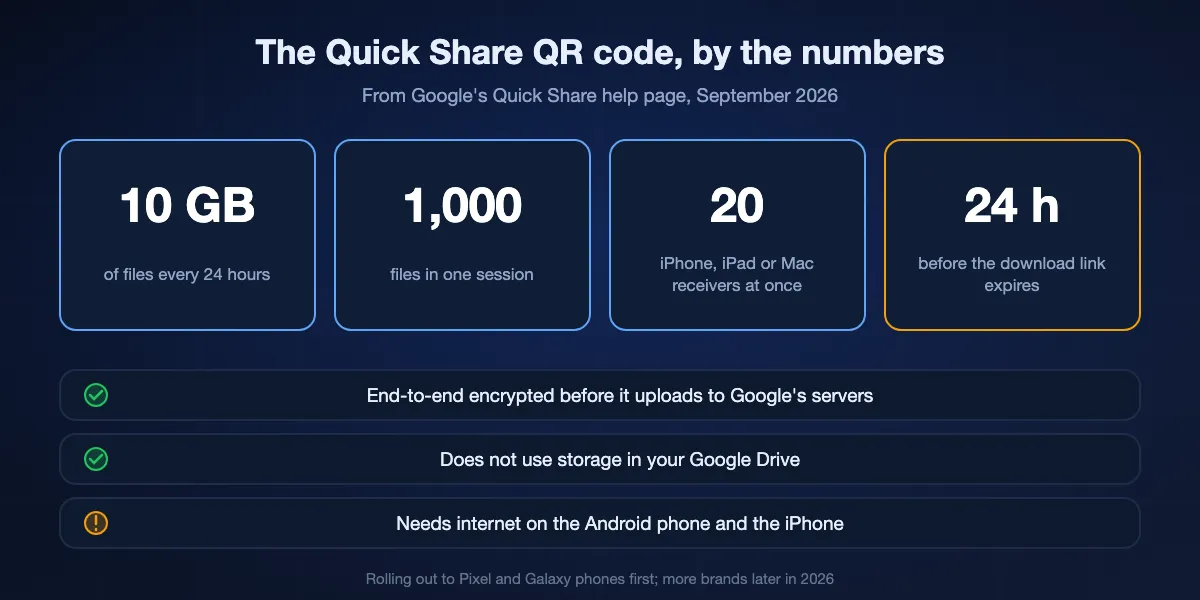
Rolling out since May 2026, first on Pixel and Galaxy phones: in Quick Share, choose Use QR code, and the iPhone scans it with its Camera to open a download link in Safari. Google says the files are end-to-end encrypted, uploaded to its servers without touching your Drive storage, available for 24 hours, and capped at 10 GB per 24 hours and 1,000 files per session. It needs internet on both phones, but no AirDrop and no app.
Android 17 can move a whole phone to iPhone
Apple's migration guide now says a supported Android device running Android 17 can transfer to a new iPhone without downloading Move to iOS, and that a USB-C cable between the two phones is faster than Wi-Fi. It is a setup-time tool for switching, not a way to send a file to an iPhone that is already in use.
Eight routes from Android to iPhone, ranked
BIShare
Best overall: any Android phone, any iPhone, near or far
Android, iOS, desktop · MIT licence, no price · phone-to-phone with no cap · 100 GB links · encrypted end to end · zero accounts
It does not care whether the Android phone is a flagship or a five-year-old budget model. Put the app on both phones, join one Wi-Fi or a hotspot, and the iPhone shows up on the Android side; tap it, accept on the iPhone, and the files cross the network directly. On the iPhone they appear in the app's inbox, where Save to photos moves pictures and videos into the Photos library, one at a time or all at once. When the iPhone is somewhere else, the Android app makes a link instead, with a QR code and a 6-character code as backups. The iPhone opens it in Safari and saves as much as 100 GB with no install; the file was encrypted on the Android phone before it left, and the link stops working after 24 hours.
Watch out for: The direct route needs the app on the iPhone too. A link is a hand-off, not storage, so download before it expires.
Quick Share to AirDrop
Best built-in option for a supported phone standing next to the iPhone
Pixel 8a and later, certain Samsung, Oppo, OnePlus, Vivo, Xiaomi, Honor, Transsion, Motorola · every iPhone · nearby only · nothing to install
On a supported Android phone this feels like AirDrop because, on the iPhone's side, it is. The iPhone owner opens Control Center and sets AirDrop to Everyone for 10 minutes; you choose the files in Quick Share and tap the iPhone. Photos and videos land in the iPhone's Photos app like any AirDrop, and other files offer to open in a matching app. No account, no upload, and it works with no internet because the two phones talk directly.
Watch out for: The iPhone has to be visible to everyone nearby while it receives, since contact-only discovery does not work across platforms. Most Android phones in circulation are not on the supported list yet.
Quick Share QR code
Best built-in option when AirDrop can't see the phone
Pixel and Galaxy first, more brands during 2026 · any iPhone with a camera · up to 10 GB per 24 hours · link lasts 24 hours · end-to-end encrypted
Where the AirDrop bridge is not available, or the iPhone refuses to appear, Quick Share can instead show a QR code. The iPhone scans it with the normal Camera app and a secure page opens in Safari with the files ready to download. Nothing is installed on the iPhone and nothing counts against your Google Drive. Galaxy phones also offer Samsung's own link and QR sharing, which needs a Samsung account on the sender and allows 10 GB per file and per day, with links that expire after two days.
Watch out for: It needs internet on both ends, a 10 GB daily ceiling, and files that land in Safari's Downloads rather than in Photos.
Google Photos or Google Drive
Best when the pictures should stay in a shared library
Android built-in, free iPhone apps · 15 GB free across Gmail, Drive and Photos · Google account on the sender · shared links open in Safari
If the Android phone already backs up to Google Photos, the pictures are halfway there. Share an album or a few items by link and the iPhone opens them in Safari, or signs into the Google Photos app and saves them to the camera roll. For documents and big videos, Drive does the same with folders. It is the natural choice for a family album that both sides keep adding to.
Watch out for: It is upload then download, so large videos are slow, it uses the 15 GB free allowance, and full resolution depends on the backup quality being set to Original.
LocalSend
Free open-source app for two phones on one network
Android, iOS and desktop · open source · local network only · encrypted · no accounts
LocalSend is a good, honest tool for the same-Wi-Fi case: both phones run it, they discover each other, and files go across without touching a server. If the Android phone and the iPhone live in the same house and only swap files in person, it covers the need.
Watch out for: No way to reach an iPhone on another network, and both people have to install it.
WhatsApp or Telegram, sent as a file
Fine inside a chat you already have
App and account on both phones · files up to 2 GB · normal photo sends are compressed
Chat apps are where most Android-to-iPhone photos actually travel, and most of them arrive smaller than they left. Attach the picture as a document or file instead of through the photo picker and it keeps its original size. On the iPhone, open the file in the chat and save it to Photos from the share sheet.
Watch out for: A 2 GB ceiling, a permanent copy in the chat, and an easy mistake that turns a sharp photo into a soft one.
A USB-C stick
Offline hand-over, iPhone 15 or newer only
Android phone with USB-C · iPhone 15 or later · exFAT drive · Files app on the iPhone
Copy files onto a drive from the Android phone's file manager, plug it into an iPhone with a USB-C port, and open the Files app, where the drive appears as a location. Format it as exFAT so files over 4 GB fit on it. From Files, photos and videos can be saved into the Photos library with the share button.
Watch out for: iPhones with a Lightning port need a camera adapter and a drive that works with it, and saving into Photos is a manual step per batch.
For one document, not for a camera roll
Any phone · attachments around 20–25 MB · no app needed · copy stays in both mailboxes
A PDF or a couple of photos attached to an email from Gmail open on the iPhone in Mail or the Gmail app. It is universal and needs no setup, which is why it is still how many people move a single file.
Watch out for: The attachment limit rules out video, and every file stays in two inboxes afterwards.
At a glance
| Feature | BIShare | Quick Share → AirDrop | Quick Share QR code | Google Photos / Drive | WhatsApp file | USB-C drive |
|---|---|---|---|---|---|---|
| Works from any Android phone | ||||||
| Works with any iPhone | ||||||
| Nothing to install on the iPhone | ||||||
| Reaches an iPhone that isn't nearby | ||||||
| Keeps original quality | ||||||
| Works with no internet | ||||||
| More than 10 GB in one go | ||||||
| End-to-end encrypted |
Checked September 2026. The BIShare tick for no install means its Safari link, good for 100 GB; sending phone to phone means the app on each device and unlimited size. Quick Share to AirDrop needs a supported Android phone and the iPhone set to Everyone for 10 minutes; Google publishes no size limit for it. The Quick Share QR code is rolling out to Pixel and Galaxy phones first, needs internet on both sides, and allows 10 GB per 24 hours. Google Photos and Drive keep originals when backup quality is Original and share by link within 15 GB of free storage. WhatsApp encrypts files end to end and stops at 2 GB each. The USB-C column assumes an iPhone 15 or newer.
Setting up a new iPhone from an Android phone
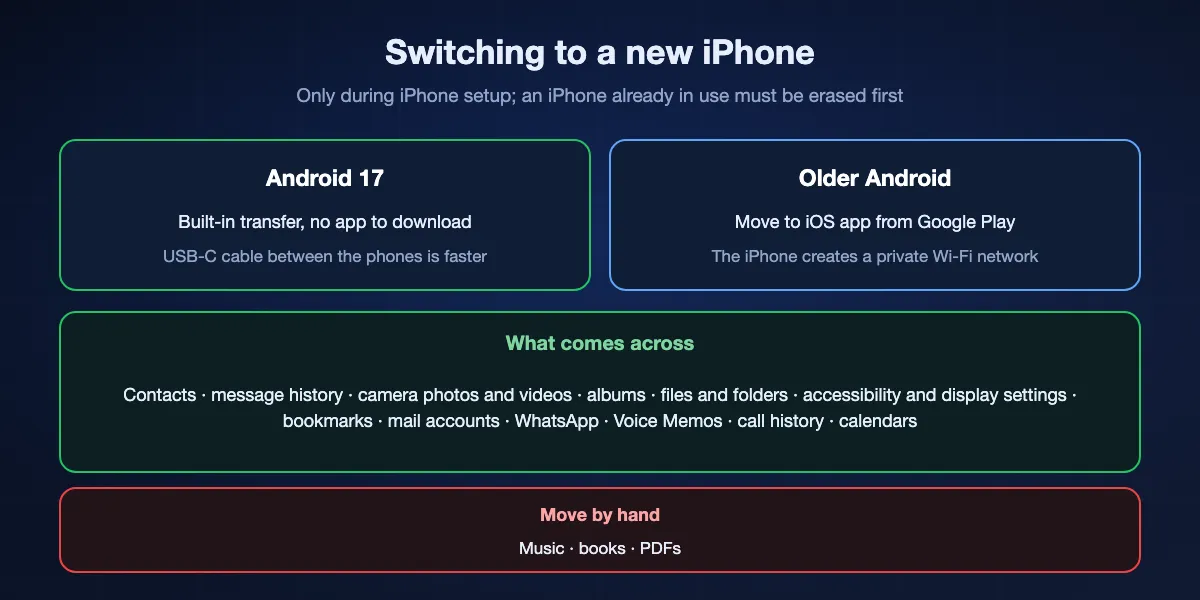
If the iPhone is replacing the Android phone, a migration during setup moves far more than any file-sharing method, including your message history. Do it before you start using the iPhone.
Android 17: no app needed
Apple's guide says a supported Android device running Android 17 can transfer straight to the new iPhone during setup. Keep both phones on power with Wi-Fi on and follow the prompts on each screen. Connecting the two with a USB-C cable makes the transfer faster.
Older Android: Move to iOS
On earlier Android versions, install Apple's Move to iOS app from Google Play, choose Move Data from Android on the iPhone's Apps & Data screen, and enter the code the iPhone shows. The iPhone creates its own private Wi-Fi network for the transfer.
What comes across, and what doesn't
Apple lists contacts, message history, camera photos and videos, photo albums, files and folders, accessibility and display settings, web bookmarks, mail accounts, WhatsApp messages and media, Voice Memos, call history and calendars, plus free apps that exist on both stores and support it. Music, books and PDFs have to be moved by hand. If the iPhone is already set up, it must be erased to run the transfer.
Where the files end up on the iPhone
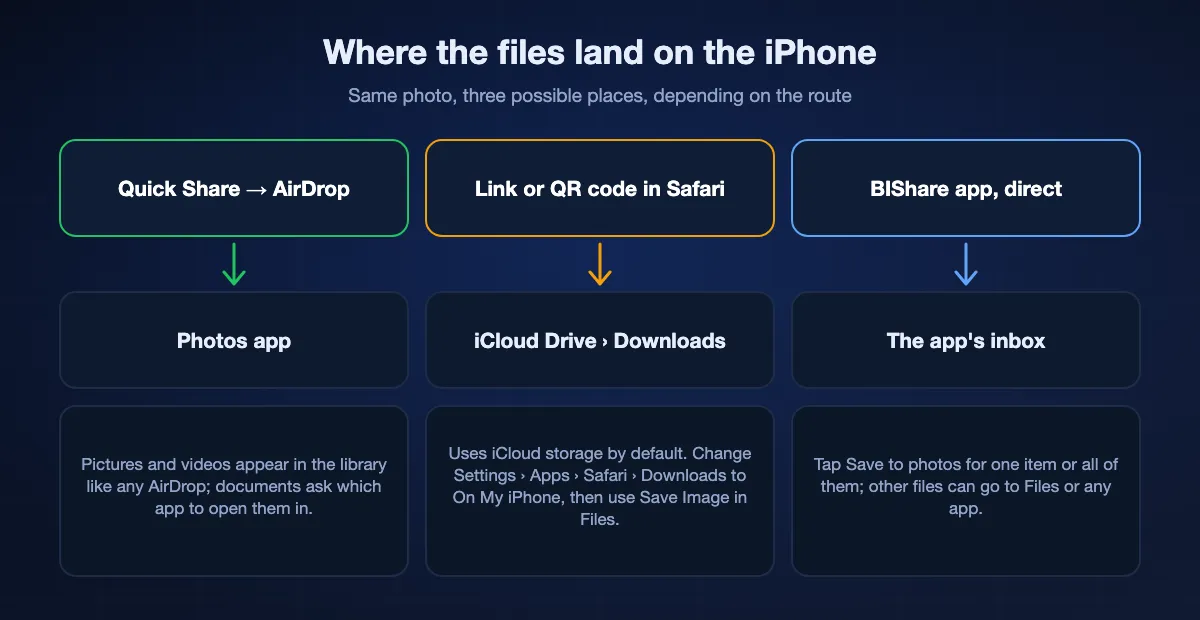
The same photo can land in three different places on an iPhone depending on how it was sent, and that is where most "it didn't arrive" confusion comes from.
AirDrop: straight into Photos
Pictures and videos sent from Quick Share to AirDrop go into the Photos app like any AirDrop. Documents ask which app should open them.
Safari downloads: iCloud Drive by default
Links and QR codes download through Safari into the Downloads folder of iCloud Drive, which uploads the file to iCloud and uses your storage. For big transfers, switch Settings, Apps, Safari, Downloads to On My iPhone first. To move a downloaded photo or video into Photos, open it in the Files app, tap Share and choose Save Image or Save Video.
The BIShare app: its inbox
Files received directly stay in the app's inbox until you decide what to do with them. Save to photos adds pictures and videos to the Photos library, and anything else can be shared to Files or another app.
Android to iPhone with BIShare
Install on both and join the same network
Install BIShare from Google Play and the App Store, then put both phones on one Wi-Fi, or turn on the Android phone's hotspot and join it from the iPhone. On the iPhone, allow BIShare to find devices on the local network when iOS asks.
Send from the Android phone
Pick photos, videos or files, tap the iPhone in the device list, and accept on the iPhone. Nothing is recompressed. Open the inbox on the iPhone and tap Save to photos for pictures and videos.
Or create a link
If the iPhone is elsewhere, tap Link in the app, or visit bishare.app/transfer in Chrome and add the files there. Share the address or its 6-character code however you like; Safari on the iPhone fetches up to 100 GB within the 24-hour window.
Motion photos, and other Android quirks on an iPhone
Motion photos arrive still
Samsung's Motion Photos and the Pixel's motion photos hide a short video inside a JPEG. The iPhone shows the picture and ignores the movement. To keep the motion, export it first: Samsung's Gallery offers Export to a video or GIF, and that file plays normally on the iPhone.
Documents open in Files
PDFs, ZIPs and office files do not go into Photos. They open in the Files app, which can unzip archives and preview most document types without another app.
Chat apps shrink what you send
A photo sent through a messenger's gallery picker is resized for the network, which is why a detailed Android shot can look soft on the iPhone. Choose a direct transfer, a link or the messenger's file option and the full-size original survives.
How long it takes
Local routes run as fast as the wireless link between the phones. Anything that goes through a server first has to squeeze through the sender's upload.
Same Wi-Fi
Current phones within sight of the router reach something like 40–50 MB/s over Wi-Fi 5, or 70–110 MB/s over Wi-Fi 6; a one-gigabyte clip is done in seconds. An Android hotspot typically manages 10–30 MB/s.
Quick Share to AirDrop
The phones connect to each other directly, so the router does not matter. Keep both screens on and the phones close for long batches.
QR codes, links and cloud
At a 50 Mbps upload, the Android phone needs about three minutes per gigabyte before the iPhone can start downloading, and a 10 GB batch takes over half an hour.
When the iPhone doesn't get the files
The iPhone isn't listed in Quick Share
Confirm the Android model appears on Google's list and runs the latest update, that the iPhone's AirDrop is set to Everyone for 10 minutes, that on a Galaxy Share with Apple devices is on, and that both phones have Bluetooth and Wi-Fi on. If it still won't appear, use the QR code instead.
Both phones are online at home, yet the app lists nothing
On the iPhone, Settings, Privacy & Security, Local Network must allow the app. Guest and hotel networks often isolate devices; use the Android phone's hotspot. A VPN on either phone can also hide it.
A big download filled up iCloud
Safari saved it to iCloud Drive. Move it to On My iPhone in the Files app, delete the iCloud copy, and change the Safari download location for next time.
The photo downloaded but isn't in Photos
Downloads land in Files, not Photos. Open the file, tap Share and choose Save Image or Save Video.
The QR link says it has expired
Google's QR shares last 24 hours and Samsung's links two days. Ask for a new code, or use a direct transfer if the phones are together.
Keeping the transfer private
Photos of children, scans of ID cards and signed contracts are exactly what people send between phones. These are the privacy trade-offs of each route.
Direct between the phones
BIShare's direct route, LocalSend and Quick Share to AirDrop never put the file on a server, and the connection between the phones is encrypted.
Through a server, sealed
BIShare links and Google's Quick Share QR codes encrypt the files end to end before they upload, so the server in between holds data it cannot read. WhatsApp files are also end-to-end encrypted but remain in both chat histories.
Through a server, readable
Google Photos, Drive, Samsung's own links and email protect files in transit, but the provider can access what it stores. Reasonable for holiday pictures; think twice for identity documents.
Android to iPhone: FAQ
Can I AirDrop from Android to an iPhone?
From some Android phones, yes. Quick Share can send to AirDrop on the Pixel 8a and later and on certain Samsung, Oppo, OnePlus, Vivo, Xiaomi, Honor, Transsion and Motorola models. AirDrop on the iPhone has to be on Everyone for 10 minutes. For every other Android phone, use an app or a link.
How do I send photos from Android to iPhone without an app?
Use Quick Share to AirDrop on a supported phone, the Quick Share QR code on a Pixel or Galaxy, or a Google Photos share link. On any Android phone, bishare.app/transfer in Chrome makes a link the iPhone opens in Safari.
What is the Quick Share QR code for iPhone?
A Quick Share option on Pixel and Galaxy phones that shows a QR code. The iPhone scans it with the Camera and downloads the files in Safari. Google says the files are end-to-end encrypted, available for 24 hours, and limited to 10 GB per 24 hours.
Can I send files from Android to iPhone via Bluetooth?
No. iPhones do not accept Bluetooth file transfers from Android phones. Use Quick Share to AirDrop, a QR code, a Wi-Fi app or a link.
How do I send a large video from Android to iPhone?
Nearby over Wi-Fi, BIShare sends it at any size. Apart, a BIShare link goes to 100 GB, Google's QR code to 10 GB per day, and a WhatsApp file to 2 GB.
Where do downloaded files go on the iPhone?
Safari downloads go to the Downloads folder in iCloud Drive unless you change Settings, Apps, Safari, Downloads to On My iPhone. To put a downloaded photo in Photos, open it in Files and choose Save Image.
Can I use Move to iOS after the iPhone is set up?
No. Apple's transfer only runs during setup; an iPhone that is already set up has to be erased first. For a few files after setup, use a direct app, a QR code or a link.
Do I still need the Move to iOS app?
Only for Android phones older than Android 17. Apple says supported Android 17 devices can transfer to a new iPhone without it, and a USB-C cable between the phones makes it faster.
Why do my motion photos stop moving on the iPhone?
Samsung and Pixel motion photos hide a video inside a JPEG, and the iPhone only shows the picture. Export the motion photo as a video or GIF on the Android phone first.
Is sending files from Android to iPhone free?
Yes. BIShare, LocalSend, Quick Share to AirDrop, the Quick Share QR code and Google Photos within its 15 GB free storage all cost nothing.
From any Android phone to any iPhone
Open source and free, no sign-up on either phone. Beam files over the local Wi-Fi when you share a sofa, and send a Safari-ready link when you are a time zone apart.