
Smash alternative
The best Smash alternatives
Smash built its reputation on one promise, and its home page still makes it without a footnote: send files without worrying about size limits, free, no sign-up. The promise is real, and among free transfer services it is still unusual. What the home page does not mention, and what the pricing page does, is the queue. Anything over 2 GB on the free plan waits behind paying customers before the recipient can collect it. For a folder you are not in a hurry about, that costs nothing. For a delivery with a deadline, it turns the one number you needed to predict into the one number you cannot. This page explains exactly how that trade works, then ranks eight alternatives on free size, link lifetime and how predictable delivery is, with every limit read from each service's own pages in September 2026.
BIShare is ours. It is not the right answer to everything below: Smash keeps files longer than we do and puts no ceiling on size at all, and where that matters the text says so plainly.
Quick answer
- You left because of the queue: a BIShare link carries up to 100 GB and starts downloading the moment the upload finishes, with nothing waiting behind anyone. It expires after 24 hours.
- You left because 7 days is not long enough: SwissTransfer keeps 50 GB for 15 days and will extend that to 30, free, without an account.
- You need the file to stay private, not just delivered: Wormhole or a BIShare link. Both scramble the file inside the browser and keep the key out of the server's reach, so neither service can open what it is holding.
- You genuinely need no size ceiling: stay on Smash, or skip the upload entirely. Two devices on one network send directly with no cap and no queue, because nothing is uploaded.
- What Smash quietly does better than most: password protection on a free transfer, which SwissTransfer matches and Dropbox, OneDrive and Smash's own listicle rivals mostly charge for.
- The honest summary: the free plans differ less in size than in certainty. Pick by whether the recipient has a deadline.
What the queue actually is, and when it costs you
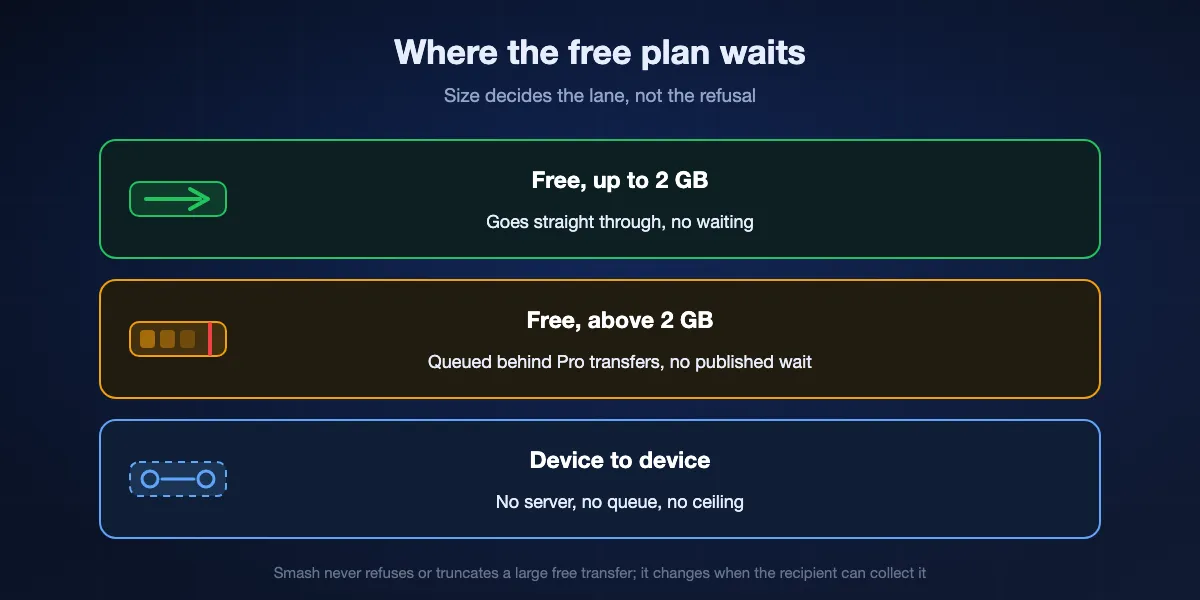
This is the part worth understanding before switching, because it decides whether Smash is the wrong tool or the right one. Smash does not refuse a large free transfer and does not truncate it. Your upload completes normally. What changes is what happens next: the pricing page says transfers beyond 2 GB join a queue behind Pro transfers, so the file waits its turn before the recipient can pull it down. The size limit everyone else imposes at the door, Smash imposes on the clock.
Why it exists at all
Someone pays for the storage and the bandwidth of a free 30 GB transfer, and on Smash that someone is the paying customer whose transfer goes first. It is a more honest bargain than a hard cap dressed up as generosity, and it is the reason Smash can advertise no size limit while WeTransfer's free plan now hands out 3 GB a month in total. The cost is simply moved from what you may send to when it arrives.
When it costs you nothing
Archives, backups, a folder of raw footage a collaborator will open next week, anything where the recipient was never going to look today. The wait is invisible because nobody is watching for the file. In that shape Smash is arguably the most generous free tier in this whole comparison, and swapping it for a service with a 5 GB ceiling would be a downgrade.
When it costs you the job
A client waiting on a call. A deadline at the end of the day. Anything where somebody asks how long it will take and the only honest answer is that it depends on how busy strangers are. That unpredictability, not the size, is why people look for an alternative, and it is the one thing no amount of free gigabytes compensates for.
The part the home page leaves out
Smash's home page promises transfers without any size limits and carries no asterisk against it. The queue appears on the pricing page, under the free column. Both statements are true together, but only one of them is on the page people land on, which is why so many users meet the queue for the first time while waiting for a delivery to go through.
Eight Smash alternatives, ranked
BIShare
Best when delivery has to be predictable, and free at any speed
No queue and no priority tier to wait behind · 100 GB a link, live for a day · unlimited once two devices share a network · scrambled before it leaves you · MIT-licensed source · phones, desktops, any browser · nothing to sign up for
BIShare answers the queue by not having one. There is no paid tier to wait behind, because there is no paid tier at all: the source is public under the MIT licence, nothing carries an advert, and no screen asks you to register. Drop up to 100 GB at bishare.app/transfer and collection can begin the instant your upload ends. The file is scrambled inside your own browser first, and the key is parked after the link's # marker, a segment browsers keep to themselves, so our storage holds bytes we have no way to open. Should the other person be on the same Wi-Fi, the app drops the upload step altogether and pushes the file across the room, where no ceiling exists.
Watch out for: Twenty-four hours is the shortest window on this page. If your recipient opens email once a week, this is the wrong tool and SwissTransfer is the right one. Executables such as .exe and .msi are refused on links.
SwissTransfer
Best when the recipient is slow and the file is large
50 GB a transfer · a fortnight on the shelf, stretchable to a month · password allowed without paying · nobody signs up at either end · browser plus iOS and Android · hosted in Switzerland by Infomaniak
If the queue is your complaint but the seven-day window was the part you liked, SwissTransfer improves on both. Fifty gigabytes per transfer, delivered by link or email, kept for fifteen days, with an offer to extend to thirty arriving before expiry. No account at either end, no ads on the download page, and password protection included the same way Smash includes it. Infomaniak, the Swiss host behind it, keeps everything in Switzerland, which some recipients in Europe treat as the deciding factor by itself.
Watch out for: Fifty gigabytes is still a ceiling, and Smash refuses to name one. Encryption covers the journey and the shelf, yet Infomaniak keeps the keys, so a court order would reach readable files.
Direct transfer between your devices
Best when the two machines sit within a few metres of each other
Nothing uploaded, so nothing to queue and nothing to cap · BIShare or LocalSend · one Wi-Fi or a phone hotspot between them · carries on with the line down · scrambled end to end · free, source published
The fastest way to beat a queue is to leave the server out of it. When both machines share a network, BIShare and LocalSend move the file straight from one to the other: nothing is uploaded, nothing is stored, nobody's Pro transfer goes first, and there is no ceiling because there is no bucket. On Wi-Fi 6 at close range we measure 70 to 110 MB/s, so a 10 GB folder lands in a couple of minutes rather than however long your upstream and someone else's queue take together. It even works with the internet down, which no link-based service can claim.
Watch out for: Only useful when the other device is nearby. For a recipient in another city this is not an option at all, and you are back to a link.
Wormhole
Best for something confidential under 10 GB that has to land today
10 GB ceiling · a browser tab, nothing installed · links die after a day · past 5 GB it runs browser to browser · AES-GCM 128-bit applied before upload · no sign-up
Wormhole trades size for certainty and privacy. Scrambling happens before a single byte leaves the tab, the key hides in the portion of the address bar that browsers refuse to transmit, and a day later the link is dead. Anything under 5 GB rests on their servers for that day; heavier files, as far as 10 GB, travel straight between the two tabs while both stay open. No paying customer goes first. For a contract, a set of masters or a scanned passport headed to one person this afternoon, nothing here is simpler or more private without an install.
Watch out for: Ten gigabytes falls far short of what Smash swallows, the browser-to-browser mode pins your tab open until they finish, and that one-day clock is fixed.
Filemail
Best when one file goes to a whole list of people
5 GB a transfer · sits on the shelf a week · no registration to send · downloaded as often as the list needs · browser only · larger ceilings sold on paid tiers
Filemail keeps the part of Smash people take for granted, which is that you can send without an account, and adds something Smash's free tier does not emphasise: no cap on downloads. Send one 5 GB link to a mailing list of two hundred people and it behaves the same on the last download as the first. The seven-day window matches Smash exactly, so switching costs you nothing in lifetime, only in ceiling.
Watch out for: Five gigabytes rules out most video work, which is precisely the case Smash was chosen for. Nothing is encrypted before upload, so the service holds readable copies.
WeTransfer
Best only when the recipient expects that name
An allowance rather than a per-send cap: ten sends or three gigabytes across a rolling month · three days before a link dies · sending needs no registration · browser and apps · bigger sends sold by subscription
WeTransfer is on this list because it is the name clients recognise, not because its free plan competes. The monthly pool is the catch: ten transfers or three gigabytes in total across a rolling thirty days, so a single large video can consume the month in one send, and the link lasts three days. If a client will only click a wetransfer.com link, that is a real business reason to use it. On limits alone, almost everything else here is more generous.
Watch out for: A monthly allowance rather than a per-transfer limit, and the shortest storage window of the link services here after BIShare and Wormhole.
Dropbox Transfer
Best when you already pay for Dropbox
Only the sender signs in · Basic hands out 2 GB and a week · subscriptions climb to 50, 100 and 250 GB, adding a password and an expiry you choose · nothing waits its turn
Dropbox Transfer sends a copy rather than sharing a folder, so the recipient downloads without touching your files or making an account. The free Basic tier matches Smash's priority threshold almost exactly at 2 GB and seven days, with no queue above it because there is nothing above it. Where it earns its place is on paid plans, which reach 50, 100 and 250 GB, adding passwords and an expiry date of your choosing, and delivery that never waits behind another customer.
Watch out for: You need an account to send, which Smash does not require, and the sizes that compete with Smash all sit behind a subscription.
Proton Drive
Best when the file should stay available and stay private
Storage, not a courier · the free 5 GB is a total, not per send · scrambled on your own machine · a public link takes a password and a closing date · opening one needs no Proton login · sending does
Proton Drive is storage rather than a transfer service, which makes it the right shape for the case Smash handles worst: a file that should still be there next month. Everything is encrypted on your device, public links take a password and an expiry date you set, and the recipient opens them in a browser without a Proton account. For a portfolio, a contract set or a folder a client returns to, permanence beats a seven-day window.
Watch out for: Five gigabytes of free storage is a total, not a per-transfer figure, and video fills it quickly. The sender needs an account, so it is no answer at all to the no-sign-up part of Smash's appeal.
At a glance
| Free plan, September 2026 | BIShare | Smash | SwissTransfer | Wormhole | Filemail | WeTransfer |
|---|---|---|---|---|---|---|
| Open source | ||||||
| Delivery never queued | ||||||
| More than 10 GB in one transfer | ||||||
| Password or one-time link | ||||||
| Encrypted before upload | ||||||
| Kept longer than 24 hours |
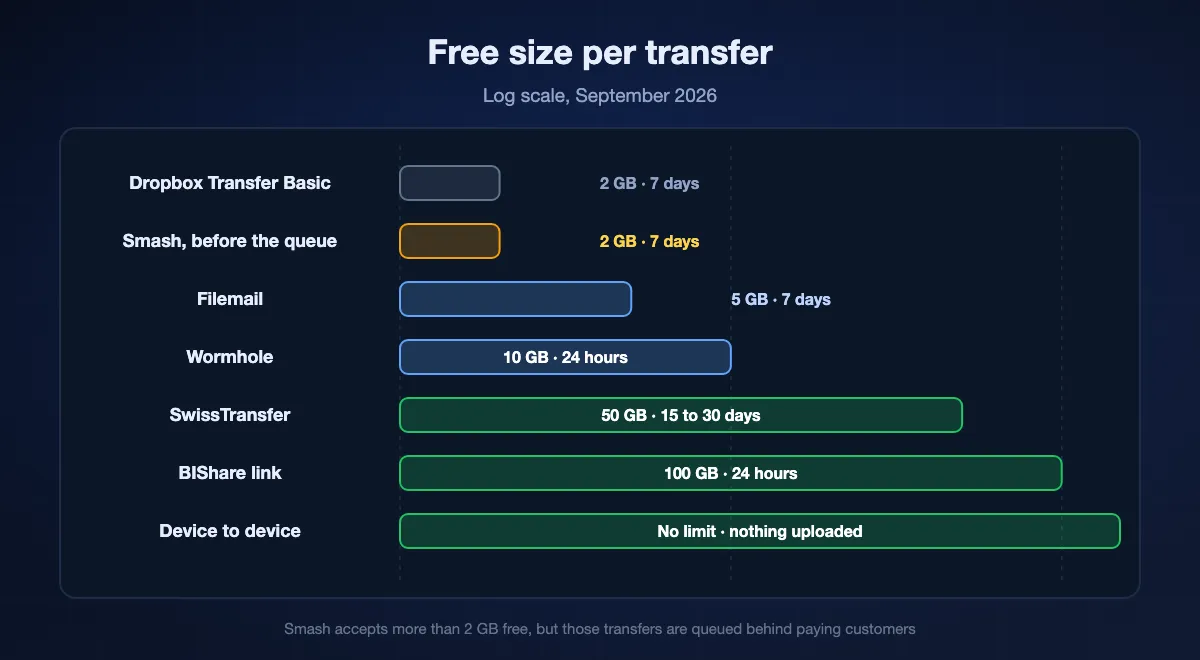
Checked against each provider's published pricing during September 2026. Smash on free: no ceiling named, anything past 2 GB waits behind Pro, a week on the shelf, password included. BIShare: a 100 GB link alive for a day, scrambled in the browser, a burn-after-reading option, and no ceiling at all between two devices sharing a network. SwissTransfer: 50 GB held a fortnight, stretchable to a month. Wormhole: 10 GB for a day, scrambled in the browser. Filemail: 5 GB for a week. WeTransfer on free: an allowance of ten sends or three gigabytes a month, links lasting three days.
How long each route really takes
Size limits are printed on pricing pages. Delivery time is not, and it is the number that decides whether a transfer was a success. Three things set it, and only one of them is about the file.
Your upload, which you can estimate
Every link service starts with the same step, and it runs at your upstream speed, not your download speed. A 10 GB transfer takes about 28 minutes on a 50 Mbps upload and about 14 on 100 Mbps, whatever logo is on the page. This part is identical across Smash, SwissTransfer, WeTransfer and a BIShare link, so it is never the reason to switch.
The queue, which you cannot
This is Smash's free-tier variable and it has no published number, because it depends on how many paying transfers are ahead of yours at that moment. Their own pricing page calls the free path non-priority. On a quiet night it may be unnoticeable; during business hours on a large file it may not be. Nobody can quote you a figure, including us.
The recipient's download, which they control
The last leg runs at their line speed. Worth remembering before blaming a service: a fast upload to a fast host still arrives slowly at someone on a weak connection. If both of you are in the same building, the whole chain collapses into one local transfer at 70 to 110 MB/s on Wi-Fi 6, which is the only route on this page with no server in the middle at all.
Moving from Smash to BIShare
Send the same way, minus the account question
Open bishare.app/transfer in a browser, or the app. No screen asks who you are, exactly as on Smash. Put in as much as 100 GB and hand over whichever suits: the link, a QR square for the handset beside you, or six characters short enough to dictate down a phone line.
Decide what you want instead of the queue
End-to-end scrambling is already on, and a single toggle destroys the link once somebody has pulled the file down. No priority setting exists, because there is nothing to be prioritised above. Collection can begin the second your upload ends.
For anything over 100 GB, or anything nearby
Install the app on both devices. On a shared Wi-Fi or a phone hotspot they find each other and send directly, with no ceiling and no upload, which also covers the case Smash handled best.
Keep Smash for the long tail
There is no reason to pick one service forever. A 60 GB archive nobody is waiting for is still a good fit for Smash's free plan, and seven days beats our twenty-four. Using the right one per job is cheaper than paying for either.
Which alternative for which job
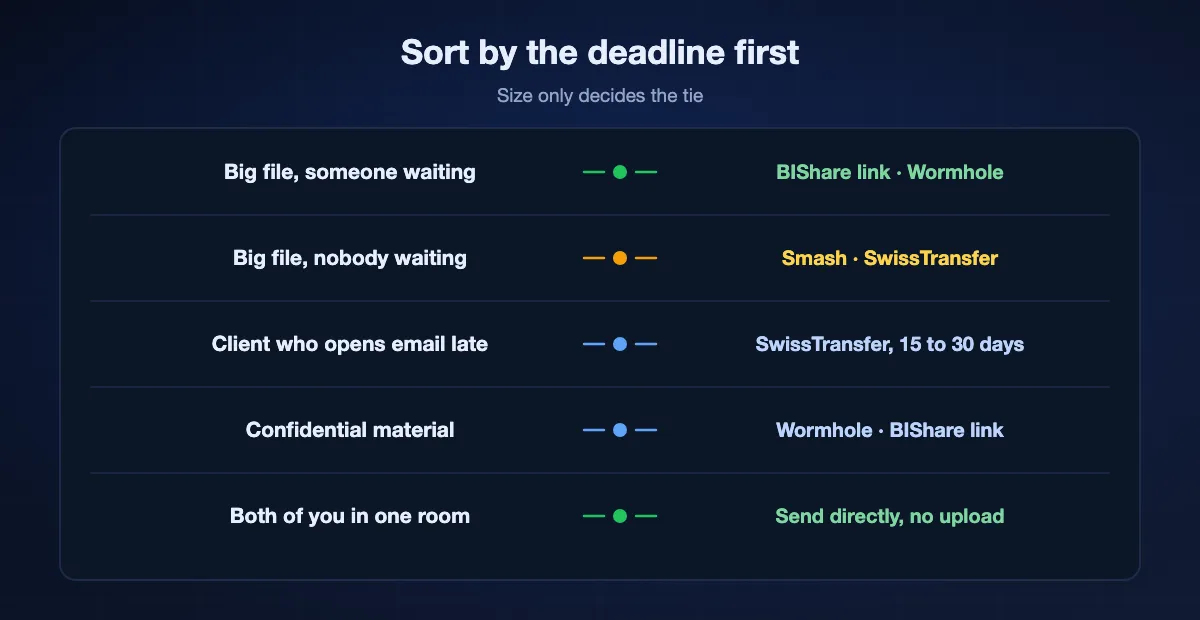
Sort by the deadline and the size, in that order. Everything else is detail.
Big file, someone waiting today
A BIShare link up to 100 GB, or Wormhole up to 10 GB. Neither queues, and both start the moment the upload finishes.
Big file, nobody waiting
Stay on Smash, or use SwissTransfer for 50 GB and a fortnight. This is the case where leaving Smash gains you nothing.
Client who opens email late
SwissTransfer, for 15 days extendable to 30. Twenty-four hours will not survive a weekend.
Confidential material
A service that encrypts before upload: Wormhole or a BIShare link, where the key sits in the link and never reaches the server.
Both of you in the same room
Send directly and skip every limit on this page. No upload, no queue, no ceiling, and it works with the internet down.
What each service can read
Every service here encrypts in transit, so that comparison decides nothing. The question that separates them is who holds the key while the file sits on a disk.
Encrypted before it leaves your device
A BIShare link and Wormhole both scramble the file inside the browser and tuck the key behind the address bar's # marker, which no browser transmits. Break into either service, or serve it with a warrant, and unreadable bytes are all that comes out. Proton Drive does its scrambling on your device too.
Encrypted, but with the service holding the key
Smash states SSL/TLS in transit and 256-bit AES at rest, and SwissTransfer, Filemail and WeTransfer are in the same category. That is appropriate for everyday work and worth a second thought for identity documents, health records or unreleased material.
Nothing stored anywhere
A direct transfer between two devices on one network writes to no server at all, so there is nothing to breach, nothing to subpoena and nothing to expire. It is the strongest position available, and it is only available when the other device is close.
Smash alternatives: FAQ
What is the best free alternative to Smash?
For predictable delivery, BIShare: 100 GB per link with no queue and no paid tier to wait behind. For a longer window, SwissTransfer at 50 GB for 15 to 30 days. If you need no size ceiling at all and nobody is waiting, Smash's own free plan is still hard to beat.
Why are my Smash transfers slow?
Most likely the queue rather than your connection. Smash's pricing page states that free transfers over 2 GB join a queue behind Pro transfers, so the recipient waits for paying customers to clear. Below 2 GB the free path is not queued.
Does Smash really have no file size limit?
Its home page says transfers without any size limits, with no footnote, and the pricing page adds that beyond 2 GB free transfers are queued and marked non-priority. Both are true: there is no ceiling on what you may send, only on when it goes.
Is Smash free forever?
The free plan needs no payment and no sign-up, keeps transfers for 7 days and includes password protection. Paid tiers add unlimited size with priority, 30-day retention, a transfer manager, download tracking, custom branding and file reception.
Which Smash alternative has no size limit?
For link transfers, none of the free alternatives are uncapped; BIShare's 100 GB is the largest here. Between two devices on the same network BIShare and LocalSend have no limit at all, because the file is never uploaded.
Can I send large files without an account, like on Smash?
Yes. BIShare, SwissTransfer, Wormhole, Filemail and WeTransfer all send from an anonymous browser tab on their free tiers. Dropbox Transfer and Proton Drive are the two here that need the sender to sign in.
Does any free alternative offer password protection?
SwissTransfer does, on free transfers, the same as Smash. BIShare and Wormhole take a different route: the decryption key is inside the link, so protection comes from sending that link privately, and BIShare adds a one-time download that kills the link after the first fetch.
How long do the alternatives keep my files?
Twenty-four hours on BIShare and Wormhole, three days on WeTransfer free, seven on Smash, Filemail and Dropbox Transfer Basic, and fifteen to thirty on SwissTransfer. Proton Drive keeps them until you delete them, within its free storage.
Is BIShare actually free, or is there a tier above it?
There is no tier above it. The source is published under the MIT licence, there are no ads, no account and no paid plan, which is also why no transfer can be queued behind a better one.
What gets a really big file there quickest?
If the other device is nearby, send directly over your own network: no upload, no size limit, and 70 to 110 MB/s on Wi-Fi 6 in our measurements. If it is not, your upstream speed sets the floor for every service equally, so choose on queueing and retention rather than on advertised speed.
Send it now, without waiting in line
Up to 100 GB per link, encrypted before upload, no account and no paid tier to be queued behind. Free and open source.