
Wormhole alternative
The best Wormhole alternatives
Wormhole got the hard part right in 2021 and almost nobody has matched it since: the file is locked inside your own tab before a byte moves, the key rides in the part of the address that browsers refuse to send, and no account is involved anywhere. The reason people go looking for a replacement is rarely the encryption. It is the line at five gigabytes. Below it your upload sits on a server for up to a day and you can walk away. Above it nothing is stored at all, the two browsers talk to each other, and your tab has to stay open until the person at the other end has finished pulling the file down. This page explains where that line falls and what it costs you, then ranks eight alternatives by whether you can close the tab, what they can read, and how long a link survives, with every limit taken from the provider's own pages in September 2026.
BIShare is ours. Wormhole is a genuinely good piece of engineering and this page says so: for a two gigabyte contract going to one person this afternoon, it is still an excellent answer and nothing below beats it on simplicity.
Quick answer
- You want the same privacy without the open tab: a BIShare link locks the file in your browser exactly the way Wormhole does, carries up to 100 GB, and then you can close everything. Collection stays possible for 6, 12 or 24 hours.
- You hit the 10 GB ceiling: a BIShare link goes to 100 GB, and transfer.zip has no stated ceiling in its free browser-to-browser mode. That mode keeps the tab requirement.
- Your recipient is slow: nothing here is slower than a dead link. SwissTransfer holds 50 GB for 15 days, and Proton Drive holds a shared file until you delete it.
- You never wanted a server involved at all: two devices on one network send straight to each other, or use FilePizza in a browser. No upload, no storage, nothing to expire.
- The limit nobody mentions: a Wormhole link also dies after a chosen number of downloads, as low as one. If a link stopped working early, that counter is the usual reason, not the clock.
- The honest summary: Wormhole is running and reachable, but its roadmap has not moved since 2021. Pick a replacement on whether you can close the tab, not on gigabytes.
The five gigabyte line, and what it actually changes
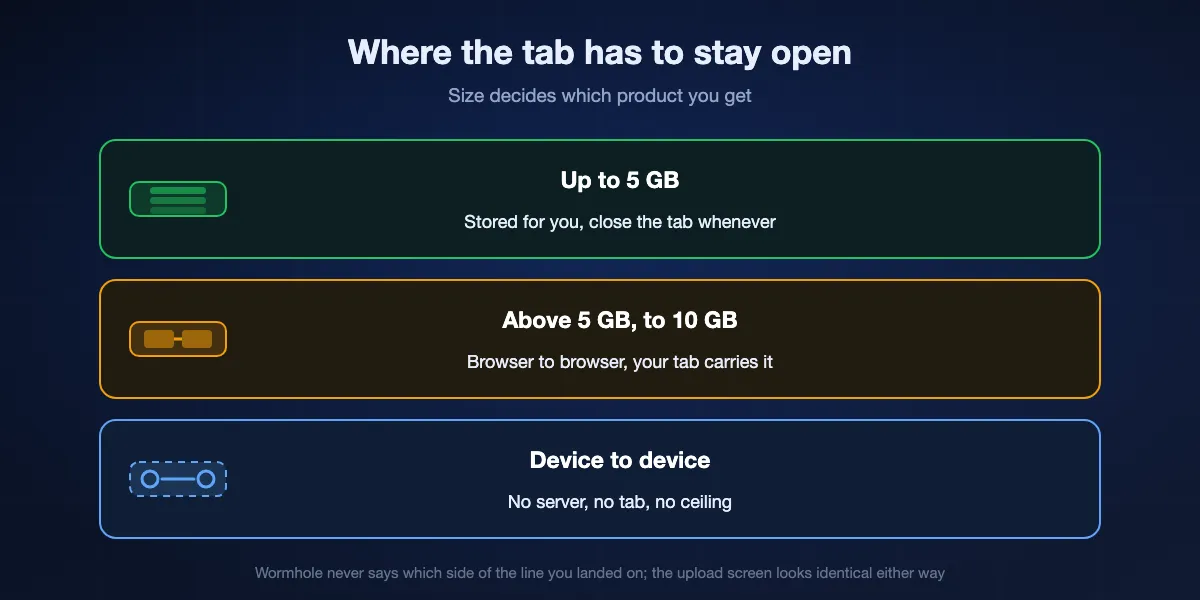
Wormhole is really two products wearing one interface, and which one you get is decided by the size of what you drop in. The FAQ states it plainly: for files up to 5 GB the service stores them for you, and above that it switches to a direct browser-to-browser route. Nothing on the upload screen warns you which side of that line you just landed on, which is why the failure people describe is always the same: the transfer looked finished, they closed the laptop, and the other person got nothing.
Under five gigabytes: ordinary and fine
Your encrypted file goes to Wormhole's storage, which sits on Backblaze, and waits there for the window you picked. Close the tab, shut the machine, go home. The recipient collects whenever. In this shape Wormhole behaves like every other link service, except that the service genuinely cannot read what it is holding, which almost none of the others can say.
Over five gigabytes: your tab becomes the server
Nothing is uploaded anywhere. The two browsers negotiate a direct path and the bytes move between them, which is why the FAQ tells you to keep the page open until the recipient has downloaded the files. That is not a bug, it is the only way to move 10 GB without paying to store it. But it means the transfer is scheduled by two people at once, and a closed laptop or a phone that locks ends it.
The download counter, which almost nobody notices
Alongside the expiry clock there is a second limit: the link also dies after a set number of downloads, which the sender picks from a list starting at one. Wormhole's own wording is that files are deleted after the time window or that many downloads, whichever comes first. No article ranking for this search mentions it, and it explains most links that stop working sooner than expected.
The clock is shorter than you think
Twenty-four hours is the maximum, not the default behaviour: the expiry is chosen at send time from a list that starts at one hour. So two people can both use Wormhole, both be correct, and describe completely different lifetimes. Worth setting deliberately rather than assuming a day.
Eight Wormhole alternatives, ranked
BIShare
Best when you want Wormhole's privacy model and the freedom to close the tab
100 GB a link · sealed in your own browser before upload · key parked in the link fragment · up to one day to collect · a burn-after-first-download switch · no ceiling at all between two devices on one network · source under Apache 2.0 · no account, no paid tier
BIShare copies the part of Wormhole worth copying and drops the part that hurts. The file is sealed inside your browser first, and the key lives after the link's # marker, a stretch of the address that browsers keep to themselves, so what our storage holds is bytes we cannot open. The difference is what happens next: the upload completes to storage at any size up to 100 GB, so you can close the lid and the recipient collects later, with no second machine waiting on yours. There are real apps too, and when both devices sit on one Wi-Fi they skip the internet entirely and push the file across the room.
Watch out for: A day is a short window, shorter than SwissTransfer or Proton Drive. Links refuse executables such as .exe and .msi. And below 5 GB, Wormhole already does this job perfectly well.
transfer.zip
Best like-for-like swap, with the same tab-open bargain
Quick Transfer mode is free and unlimited · browser to browser, nothing stored · both tabs stay open · encrypted end to end · no account · open source · stored links and long expiry are the paid product
Of everything here, this is the closest thing to Wormhole above its five gigabyte line. Quick Transfer streams between two browsers in real time, their own description says nothing is stored on their servers, and there is no size figure to hit. If what you liked about Wormhole was that no company ever holds your file, and the tab requirement never bothered you, this is a straight swap that removes the ceiling.
Watch out for: The free mode is the streaming one, so the sender still waits with a tab open. Paid stored transfers are a different product with a weaker promise: encrypted at rest on their servers rather than sealed by you. Read which one you are buying.
FilePizza
Best when you want proof that no server is involved
Pure browser-to-browser over WebRTC · nothing uploaded and nothing stored · both tabs open for the whole transfer · no account and no size figure · open source and genuinely active, last change September 2026
FilePizza has done one thing since 2014 and still does it: you open a page, pick a file, hand over the link, and the bytes go straight from your browser to theirs while both tabs are open. No storage means nothing to expire, nothing to subpoena and no download counter. Unlike most of this list it is visibly maintained, with commits this month, which matters if you are leaving Wormhole because its roadmap stalled.
Watch out for: Everything the tab requirement implies, permanently: no closing the laptop, no queueing a transfer for tonight, no second recipient tomorrow. There is no password either, because there is nothing sitting anywhere to protect.
Sending directly between two devices
Best when both machines are yours or in the same room
No upload at all, so no ceiling, no clock and no counter · BIShare or LocalSend · one Wi-Fi or a phone hotspot is enough · keeps working with the internet down · sealed end to end · free, source published
If the reason you liked Wormhole was that a company never held your file, a direct transfer between two devices on one network takes that further: not only does nobody store it, nothing leaves the building. We measure between 70 and 110 MB/s on a close-range Wi-Fi 6 link, so a 20 GB folder moves in a few minutes, and neither tab nor server has any say in it. It also survives an outage, which no browser-based route can.
Watch out for: Useless for a recipient in another city, which is most of the time. Both sides install something, where Wormhole asks for nothing at all.
SwissTransfer
Best when a long shelf life matters more than sealing
50 GB a transfer · kept 15 days, with an extension to 30 offered before it lapses · password allowed without paying · browser plus phone apps · run in Switzerland by Infomaniak
This is the opposite trade from Wormhole: much more room and a far longer window, in exchange for a company that can read the file. Fifty gigabytes, held a fortnight, with an offer to stretch it to thirty days arriving before expiry, and password protection included free. When your problem is a client who opens email on Monday, no amount of end-to-end sealing helps and this does.
Watch out for: Not end to end, whatever directories claim: Infomaniak's own documentation says files are encrypted once they reach its storage, so the keys are theirs. Sending now needs an emailed verification code, so the no-account claim no longer holds. Sending is also blocked outright in around sixty countries, Indonesia, India, China, Malaysia and the Philippines among them, though receiving is not.
A public Send instance
Best when you want the old Firefox Send behaviour and accept the risk
The best-known public instance caps a transfer at 2.5 GiB · at most 20 downloads · three days maximum, and shorter if you choose · sealed in the browser like Wormhole · no account · open source
Firefox Send itself is gone and Mozilla archived the code in 2021, but the community fork still runs on volunteer instances, and the well-known one answers today: I read its live configuration rather than trusting a listicle, and it reports a 2.5 GiB limit, twenty downloads and a three day maximum. The model is exactly Wormhole's, key in the link and ciphertext on the server.
Watch out for: One volunteer instance on a codebase whose last change was July 2025. It works today and nobody owes you tomorrow. The 2.5 GiB cap is also the smallest here, well under what Wormhole takes.
Proton Drive
Best when the file must still be there next month
5 GB of free storage in total, not per send · encrypted on your device · share links take a password and an expiry you choose · no cap on how many times a link is used · the recipient needs no Proton account · the sender does
Proton Drive answers the case Wormhole deliberately refuses: permanence. Encryption still happens on your machine, so the privacy model survives, but the file stays until you remove it rather than evaporating after a day and a handful of downloads. Share links take a password and an expiry date you set, and Proton states there is no limit on downloads per link or on how many links you make.
Watch out for: Five gigabytes is your whole account, not one transfer, and video eats it. The sender must register, which is exactly what Wormhole users are avoiding.
Tresorit Send
Best when a corporate recipient wants a name they recognise
5 GB a send · password protection · encrypted before it leaves your device · no registration to send · from the company behind Tresorit
Still live, still free, and still asks for nothing: its own page offers 5 GB with password protection and no registration, with files encrypted before they leave the device. The appeal over Wormhole is institutional rather than technical, since a compliance officer who has never heard of Wormhole has usually heard of Tresorit.
Watch out for: Five gigabytes is half of Wormhole's ceiling and lands exactly where the peer-to-peer trouble starts. The often-quoted seven days and ten downloads come from Tresorit's 2018 launch post and I could not confirm them on a current page this month, so treat those two numbers as unverified.
At a glance
| Free plan, September 2026 | BIShare | Wormhole | transfer.zip | SwissTransfer | Send instance | Proton Drive |
|---|---|---|---|---|---|---|
| Sealed in the browser, before upload | ||||||
| Sender can close the tab at any size | ||||||
| More than 10 GB in one go | ||||||
| Sender needs no account | ||||||
| Available for longer than three days | ||||||
| Open source |
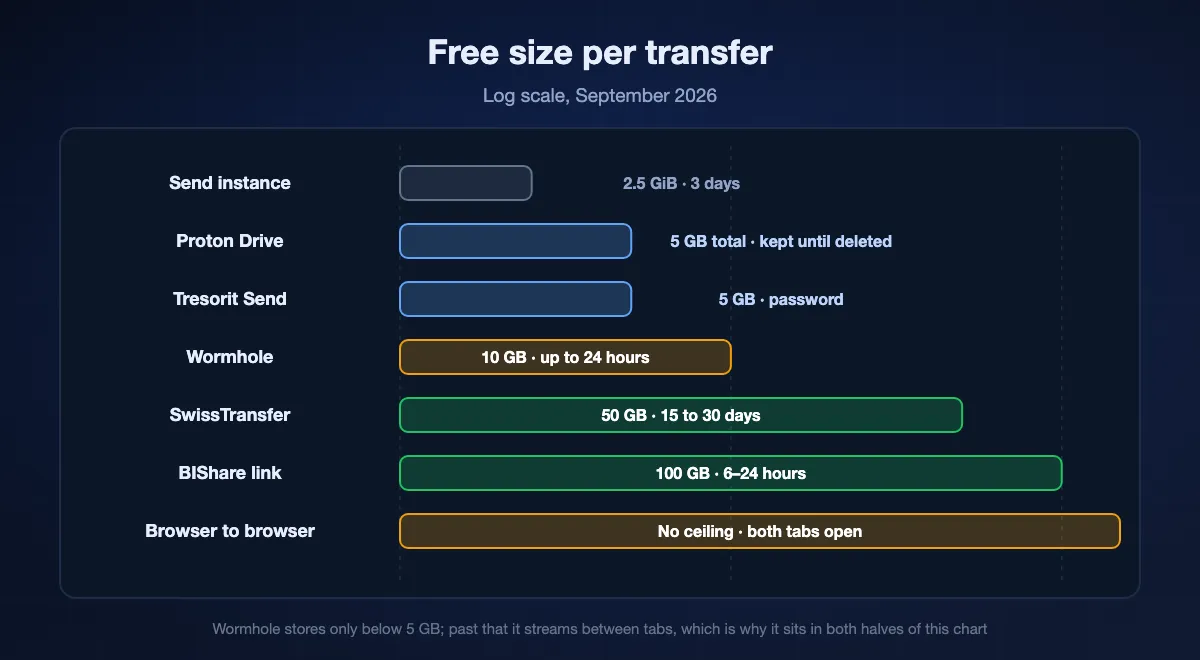
Read from each provider in September 2026. Wormhole: 10 GB on the home page, up to a day chosen at send time, a download counter starting at one, and storage only below 5 GB, above which the sender's tab carries the transfer. BIShare: 100 GB, up to a day to collect, sealed in the browser, optional burn after the first download, and no ceiling between two devices on one network. transfer.zip: the free Quick Transfer mode streams between browsers with nothing stored, so the tab column is what it is; paid stored transfers behave differently. SwissTransfer: 50 GB for 15 days, extendable to 30, but encrypted on arrival at Infomaniak rather than by you, and an emailed code is now required. Send instance: figures read live from the best-known public instance, 2.5 GiB and three days. Proton Drive: 5 GB of account storage, kept until deleted. Wormhole publishes its encryption library but not the service, which is why its open source column reads as it does.
Three different things are called Wormhole
This search is unusually polluted, and the top results do not sort it out: one page-one result is a blockchain bridge and one directory carries two separate Wormhole entries. Before choosing a replacement, check which one you were using.
wormhole.app, the browser one
A web page you drop files into, which gives back a link ending in a # and a long key. Made by the team behind WebTorrent, free, no account, no paid tier. This is the one this page is about, and the one almost everybody means.
magic-wormhole, the terminal one
A completely separate project: you type a send command, it prints a short code such as 7-crossover-clockwork, and the other person types that code to receive. Different authors, different design, still developed, with desktop front ends and a recent mobile client from an unrelated developer. If you used a code rather than a link, this is yours, and none of the browser services below replace it.
Wormhole the crypto bridge
A blockchain protocol with the same name and no connection to file transfer at all. It outranks the file tool for some searches, which is worth knowing before you follow a result that suddenly starts discussing tokens.
Moving from Wormhole to BIShare
Same habit, same privacy, no account
Open bishare.app/transfer and drop the files in. Nothing asks who you are, just as nothing does on Wormhole. Sealing happens in your browser and the key goes after the # in the link, so the address you send is the whole secret. Hand it over as a link, a QR square, or six characters short enough to read out loud.
Then close the tab
This is the whole point of the move. The upload finishes to storage at any size up to 100 GB, so there is no peer waiting on your machine and no line above which the rules change. Shut the laptop and the recipient still collects, for the next 6, 12 or 24 hours.
Set the burn switch if you wanted a low download count
If you were using Wormhole's download limit to make a link one-shot, turn on the single-collection option and the link dies the moment the file is pulled. If you were not using it, leave it alone and the link simply expires with the clock.
For anything past 100 GB, or anyone nearby
Install the app on both devices. On a shared network or a phone hotspot they pair up and move the file between themselves, nothing uploaded and no ceiling, which covers the same case Wormhole reaches for above 5 GB without either tab staying open.
Which alternative for which job
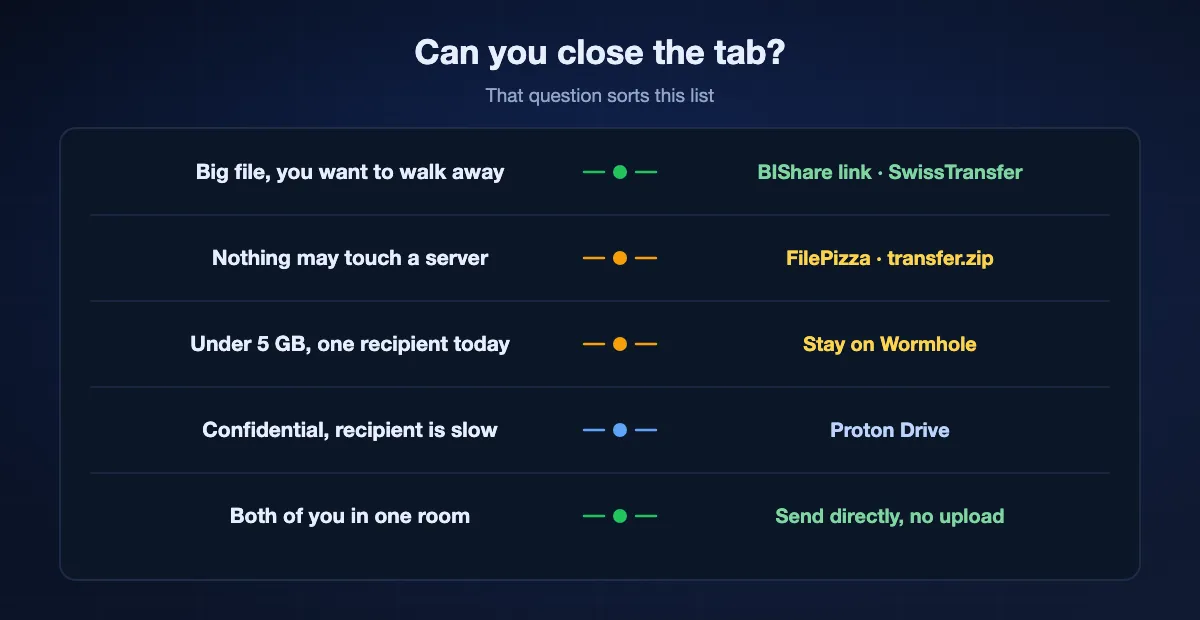
One question sorts this list faster than any other: does someone have to sit and wait with a tab open.
Big file, and you want to walk away
A BIShare link up to 100 GB, or SwissTransfer up to 50 GB if you can live without end-to-end sealing. Both finish to storage, so nothing waits on your machine.
Nothing may ever touch a server
FilePizza, transfer.zip in Quick Transfer mode, or Wormhole itself above 5 GB. All three make your tab the server, and that is the price.
Under 5 GB and going to one person today
Stay on Wormhole. It stores, it seals, it needs no account, and switching gains you nothing at that size.
Confidential, and the recipient is slow
Pick on who holds the key, not on the marketing. Proton Drive keeps a sealed file available indefinitely; a BIShare link gives you up to a day; SwissTransfer gives a fortnight but can read what it holds.
Both of you in the same room
Send device to device and every limit on this page disappears at once. No upload, no counter, no clock, and it keeps going with the line down.
What each service can read
Wormhole set the standard here, so it is the right yardstick: the file is sealed with 128-bit AES-GCM before it leaves the browser and the key never reaches the server. Measure the others against that rather than against the word encrypted.
Sealed by you, key in the link
Wormhole, a BIShare link, a Send instance and transfer.zip's free mode all work this way. The service stores or relays bytes it has no key for, so a breach or a court order produces nothing readable. The flip side is that whoever holds the link holds the file, which makes how you send the link the real security decision.
Sealed on your device, held in an account
Proton Drive encrypts locally too, but the file lives in storage tied to you rather than in a disposable link. That is stronger for durability and weaker for anonymity, which is the correct trade for a contract set and the wrong one for a one-off handover.
Encrypted, by the company, once it arrives
SwissTransfer, Smash, WeTransfer and Filemail belong here. Infomaniak's own documentation is refreshingly direct about it, saying files are encrypted as they arrive on its servers, which means Infomaniak has the keys. Fine for everyday work, wrong for identity documents or unreleased material.
Wormhole alternatives: FAQ
What is the best alternative to Wormhole?
If you want the same in-browser encryption without keeping a tab open, BIShare: 100 GB a link, sealed before upload, no account, up to 24 hours to collect. If you want the same browser-to-browser behaviour with no ceiling, transfer.zip's free Quick Transfer or FilePizza. If you need a long window more than you need sealing, SwissTransfer.
Is there a Wormhole app?
wormhole.app runs in a web browser on phones and computers alike, so there is nothing to install. Store apps with Wormhole in the name are other projects, such as clients for magic-wormhole. If you would rather have an installed app that keeps sending without a browser tab, BIShare has apps for iPhone, Android, Windows, Mac and Linux, and LocalSend covers devices on one network.
Why did my Wormhole transfer fail when I closed the tab?
Because the file was over 5 GB. Wormhole stores files up to 5 GB and switches to a direct browser-to-browser route above that, and its FAQ says to keep the page open until the recipient has downloaded. Under 5 GB, closing the tab is safe.
What is the Wormhole file size limit?
Ten gigabytes, stated on the home page. Confusingly the FAQ entry about maximum size never gives the number, and only explains the 5 GB storage split, so people reading the FAQ often never learn the cap at all.
Why did my Wormhole link expire early?
Two clocks, not one. The sender picks an expiry as short as an hour, and separately picks a maximum number of downloads that can be as low as one. Wormhole deletes the file at whichever arrives first, so a link can die minutes after the first download.
Is Wormhole still maintained?
It is running and reachable, and its terms were updated in July 2025, but the product itself has not moved. Its roadmap still lists a Pro plan, mobile apps and password protection as future work, and the most recent linked announcement is from 2021. Treat it as maintained but not developed.
Is Wormhole actually secure?
Its design is sound and unusually well documented: 128-bit AES-GCM applied before anything leaves the browser, keys derived with HKDF and SHA-256, and the secret placed in the URL fragment, which browsers never transmit. The practical weak point is not the cryptography but the link, since anyone who gets it can open the file.
Which Wormhole alternatives keep files for more than a day?
SwissTransfer holds 50 GB for 15 days with an extension to 30 offered before it lapses, and Proton Drive keeps a shared file until you delete it, within 5 GB of free storage. A public Send instance allows up to three days. BIShare, like Wormhole, gives you 24 hours at most.
Is there a Wormhole alternative with no size limit?
In the browser, transfer.zip's free Quick Transfer names no ceiling, and FilePizza has none either, but both stream between tabs the way Wormhole does above 5 GB. For a stored link, nothing here beats BIShare's 100 GB. Across one local network the question does not arise, since the file is never uploaded.
Is Firefox Send an alternative to Wormhole?
Not as Mozilla's product. Firefox Send shut down in 2020 and the code was archived in 2021. What survives is a community fork on volunteer-run instances, and the best known one currently allows 2.5 GiB, twenty downloads and three days. The fork's last code change was July 2025.
I used a short code, not a link. Is that the same Wormhole?
No. That is magic-wormhole, a separate command-line project with its own authors, where both sides type a code such as 7-crossover-clockwork. It is still actively developed and has desktop front ends. None of the browser services on this page replace it, and the two are constantly confused in listicles.
Same sealed link, and you can close the tab
Up to 100 GB, locked in your browser before upload, the key in the link, no account and no paid tier. Free and open source.