
Cross-platform transfer
AirDrop for Windows
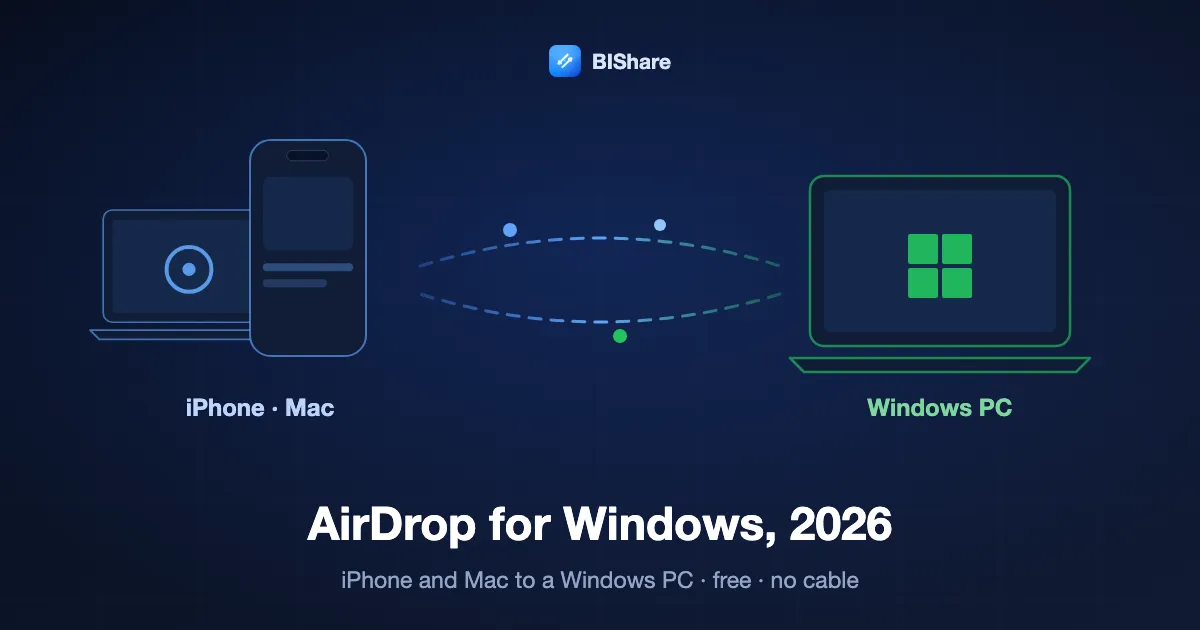
AirDrop only works between Apple devices; Windows has never had it. BIShare is the free, open-source app that does the same job between an iPhone or Mac and a Windows PC — plus Android and Linux — over your own Wi-Fi, or with a link the other side opens in any browser. Free, no account, and nothing to install on the receiving end.
Quick answer
- AirDrop does not exist on Windows. It runs on Apple-only protocols, so no download called "AirDrop for Windows" is real — treat any .exe with that name as unsafe.
- Closest thing that works today: BIShare — free on the Microsoft Store for Windows 10 and 11, with matching apps for iPhone, Mac, Android and Linux. Send in both directions over Wi-Fi, no account.
- Nothing to install? Open bishare.app/transfer in any browser on the PC and drop the file from the phone — same Wi-Fi or a link, encrypted before it leaves the device.
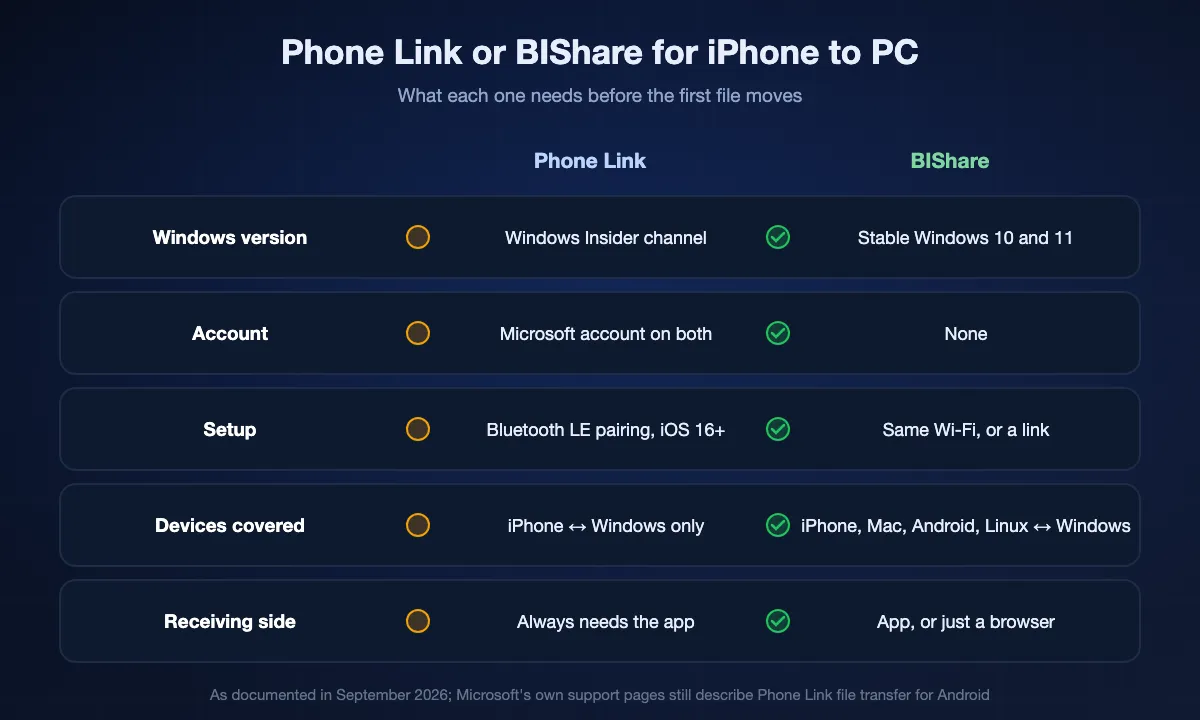
- Microsoft's own option: Phone Link can share files with an iPhone on Windows Insider builds (iOS 16+, Bluetooth pairing, Microsoft account). It does not cover a Mac, and it is not on stable Windows for everyone yet.
Why AirDrop can’t reach Windows
AirDrop runs on Apple-only protocols, so it works between iPhones, iPads and Macs — never a Windows PC, and Apple has never published the protocol for anyone else to implement. Windows 11's Nearby Sharing only talks to other Windows PCs. Microsoft's Phone Link added iPhone file sharing in December 2024, but only on Windows Insider builds and only for the phone — a Mac still has no path to a PC. That everyday case, pulling a photo or a document from an iPhone or a Mac onto a Windows laptop, is exactly what BIShare covers.
What about Phone Link? Microsoft's answer, honestly
Since December 2024, Phone Link can send files between an iPhone and a Windows 11 or Windows 10 PC. It is the closest thing to built-in AirDrop that Microsoft offers, and if you are an Insider it is worth a try. What it needs, and where it stops:
- Windows Insider Program membership — Microsoft's own support pages still document file transfer for Android only.
- iPhone on iOS 16 or later, the Link to Windows app from the App Store, and Phone Link 1.24112.89.0 or later on the PC.
- A Bluetooth pairing between the phone and a PC with Bluetooth Low Energy, plus a Microsoft account on both sides.
- iPhone ↔ Windows only. It cannot send from a Mac to a PC, from a PC to a Mac, or to Linux, and the receiving side always needs the app.
BIShare runs on stable Windows today, needs no account or Bluetooth pairing, and covers the Mac too. If you only ever move files from an iPhone and you are on the Insider channel, Phone Link is a fine built-in choice; for everything else, keep reading.
AirDrop for Windows free download — the real one
Searching for an "AirDrop for Windows download" returns installers that are either paid transfer suites or nothing to do with AirDrop at all. The app below is free, open source (MIT), signed, and published by us on the Microsoft Store.
Windows 10 and Windows 11, 64-bit. No account, no ads, no paid tier.
Or from a terminal:
winget install BIShareProject.BISharePackage BIShareProject.BIShare on winget; a Scoop manifest is in the repository too.
On the iPhone or Mac, install from the App Store; on Android, from Google Play. If the other person cannot install anything, the browser route below needs nothing on their side.


How BIShare sends iPhone / Mac ↔ Windows
On the same Wi-Fi
Files go straight from device to device, end-to-end encrypted — nothing is stored on a server. It’s fast, and it even works over a phone hotspot with no internet at all.
When you’re apart
You get a link, a QR code, and a 6-character code. On the Windows PC, open the link in any browser and download — no app, no sign-up. The link auto-expires in 24 hours.
Every platform
iPhone, Mac, Windows, Android, and Linux — one app, every direction. Send from your phone to your PC, or your PC to anyone.
Which route for which job
Photos and videos from an iPhone to a Windows PC
Install BIShare on both, pick the photos on the phone, tap the PC. They arrive at original quality — HEIC, ProRAW and 4K video untouched, no recompression and no 25 MB email ceiling. Same route the other way when you want them back on the phone.
One large video from a Mac to a PC
The case AirDrop and Phone Link both leave out. On the same network the transfer runs at local Wi-Fi speed and the only limit is free disk space on the PC; a 20 GB export is an ordinary transfer, not a special case.
Sending to someone else's Windows PC
They install nothing: open bishare.app/transfer on their PC and you send from your phone. Same Wi-Fi and their PC appears by itself; different networks and you hand them a link, a QR code or a 6-character code. The file is encrypted before it leaves your device, and the link expires in 24 hours.
No Wi-Fi at all — a car, a site visit, a plane
Turn on the phone's hotspot and join the PC to it. Nothing in the local route needs the internet, so it works with mobile data switched off. Speed is whatever the hotspot manages, typically 10–30 MB/s on a modern phone.
Hotel, café or office Wi-Fi
These networks often isolate clients from each other, so no local tool can see the PC — that is the network, not the app. Use the link route (it goes over the internet), or a hotspot, which puts both devices on a network you control.
Two ways to do it: instantly, or set up once
The first line needs nothing installed and works right now — that's the one to use when you just want this file across. The rest is the five-minute setup worth doing if you move files between these devices often.
- 01
Right now, with nothing installed
On the PC, open bishare.app/transfer in any browser. Drop the file in from the phone — same Wi-Fi and the PC appears by itself; different networks and you get a link plus a 6-character code. Nothing to install on either side, no account, and the file is encrypted before it leaves the device.
- 02
Install BIShare on the PC
Install it from the Microsoft Store (or the portable .zip). There is no account to create and nothing to configure — the app opens on a device list and starts listening for transfers straight away.
- 03
Install it on the phone or Mac
Get it from the App Store or Google Play. Both devices need it for the direct route; if the other person can't install anything, skip to the browser method below — it needs nothing on their side.
- 04
Put both devices on the same Wi-Fi
Any shared network works, including a guest network, as long as both are on the same one. No internet connection is required — a phone hotspot with mobile data switched off is a perfectly good network for this.
- 05
Grant the local-network permission
On the first launch, iOS asks for local network access and Windows asks to allow the app through the firewall. Say yes to both. Declining is the single most common reason two devices can't see each other later.
- 06
Pick the file, tap the device
Your PC appears in the list on the phone within a second or two. Choose what to send, tap the PC, and accept the prompt on the Windows side. The file lands at full original quality with no size limit.
Both directions, not just one
iPhone or Mac → Windows PC
The common case: photos, videos and documents off the phone and onto the computer at local Wi-Fi speed, with the original file intact — no recompression, no 25 MB email ceiling, and nothing uploaded to a server on the way.
Windows PC → iPhone or Mac
The same route in reverse, which AirDrop has never offered at all. Drag files onto the PC app and send them to the phone; large videos and folders work the same way as small ones, because the limit is disk space rather than an upload quota.
If the PC and phone can't see each other
Check they're on the same network, not just the same room
Guest networks are separate networks, and some routers keep the 2.4 GHz and 5 GHz bands isolated from each other. Confirm both devices show the identical network name, then try again.
Let the app through the Windows firewall
If the prompt was dismissed the first time, open Windows Security → Firewall & network protection → Allow an app through firewall, and tick BIShare for private networks.
Public Wi-Fi often blocks device-to-device traffic
Cafés and hotels commonly enable client isolation, which stops devices on the same access point from reaching each other. Nothing on your side fixes it — switch to a phone hotspot, which puts both devices on a network you control.
Other ways people try, and where each one stops
Phone Link (Microsoft)
Real iPhone ↔ Windows file sharing, but Windows Insider builds only, with iOS 16+, a Bluetooth pairing and a Microsoft account. Nothing for a Mac. Details in the section above.
Nearby Sharing (Windows 11/10)
Built in and fine between two Windows PCs. It does not see an iPhone, a Mac or an Android phone at all.
LocalSend
Free, open source and good on a shared Wi-Fi — every device needs the app, and there is no link route when the other person is on a different network or cannot install anything.
Snapdrop / PairDrop
Browser only, same network only. Handy for a one-off between two laptops; on a network with client isolation, or across the internet, the devices never find each other.
SHAREit, Xender and similar
Fast on paper, but ad-supported, heavy on permissions, and repeatedly flagged for security problems. Not a tool to put on a work PC.
iCloud, Google Drive, Dropbox
Works, but every file goes up to a server and back down, uses your quota, and needs an account on both sides. A 10 GB video takes as long as your upload speed allows.
A cable, iTunes or the Windows Photos app
Reliable for photos from an iPhone, with a cable and a driver install. Nothing for a Mac to PC, nothing for the reverse direction, and nothing for sending to another person.
Email or a chat app
Compresses photos, caps files at 25 MB or so, and stores a copy on someone's server. Fine for a document, wrong for anything you care about the quality of.
How fast is it, really
On the local route the bottleneck is the wireless link, not the app. Numbers we measure between a phone and a Windows PC, with what a 1 GB file takes:
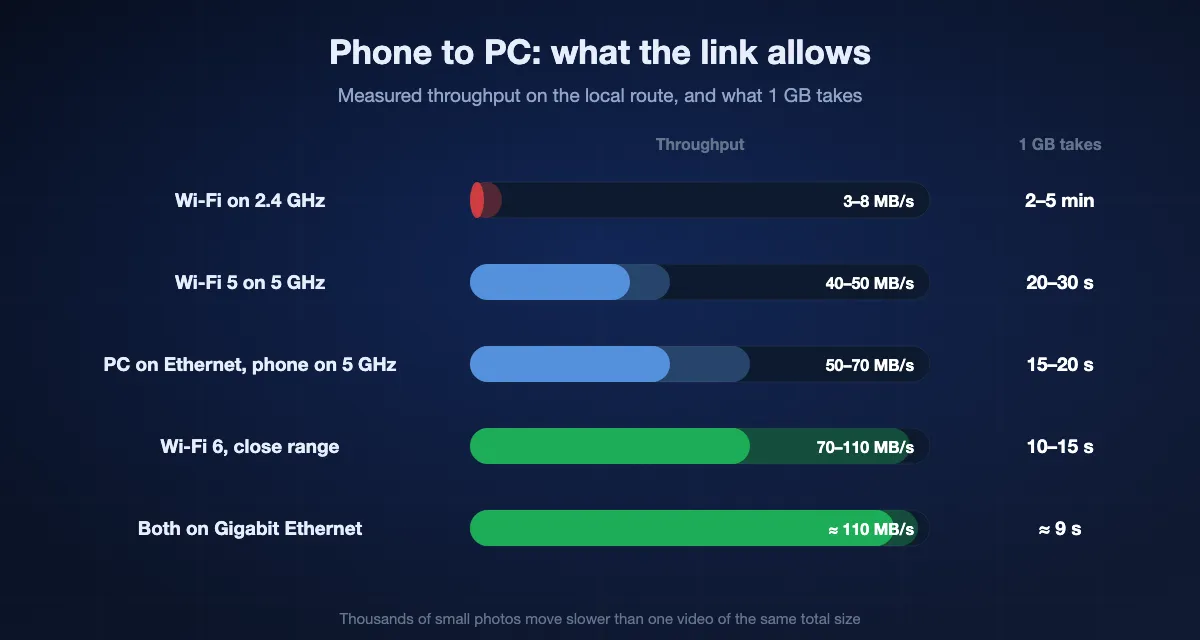
| Link between the devices | Realistic throughput | 1 GB takes about |
|---|---|---|
| Wi-Fi on 2.4 GHz | 3–8 MB/s | 2–5 minutes |
| Wi-Fi 5 on 5 GHz | 40–50 MB/s | 20–30 seconds |
| Wi-Fi 6 on 5/6 GHz, close range | 70–110 MB/s | 10–15 seconds |
| PC on Gigabit Ethernet, phone on 5 GHz | 50–70 MB/s | 15–20 seconds |
| Both on Gigabit Ethernet | 110 MB/s | about 9 seconds |
Thousands of small photos are slower than one big video of the same total size: each file carries a fixed cost for metadata, a disk write and a Windows antivirus check. The link route depends on your internet upload speed instead. Why the numbers fall short, and what fixes each case, is in our guide to AirDrop-for-Windows speeds.
What leaves your device, and what doesn't
- On the same network the file goes straight from one device to the other, encrypted for that transfer. No server sees it and nothing is stored anywhere but on the receiving PC.
- On the link route the file is encrypted in your browser or app before upload. The key travels in the link after the # sign, which browsers never send to a server, so what our storage holds is ciphertext it cannot open. Links expire in 24 hours; you can also make one that self-destructs after the first download.
- There is no account, no contact upload and no ad SDK. The Windows app is signed and published by us on the Microsoft Store; the source code for every platform is public.
AirDrop vs Phone Link vs Nearby Sharing vs LocalSend vs BIShare
Checked September 2026. Phone Link marks reflect Windows Insider builds — on stable Windows it does not talk to an iPhone yet.
| AirDrop | Phone Link* | Nearby Sharing (Windows) | LocalSend | BIShare | |
|---|---|---|---|---|---|
| iPhone → Windows | |||||
| Mac → Windows | |||||
| Windows → iPhone | |||||
| Works with Android too | |||||
| Nothing to install on the receiving side | |||||
| No account needed | |||||
| Works on stable Windows 11/10 today | |||||
| Works with no internet (hotspot) | |||||
| End-to-end encrypted |
* Phone Link: Windows Insider builds only, iOS 16+, Bluetooth pairing and a Microsoft account. Nearby Sharing: Windows-to-Windows only.
iPhone & Mac to Windows: FAQ
Does AirDrop work on Windows?
No. AirDrop is an Apple-only feature and there is no AirDrop app for Windows. To send between an iPhone or Mac and a Windows PC you need a cross-platform tool like BIShare, which works in every direction.
How do I AirDrop from iPhone to a Windows PC?
You can’t use AirDrop itself, but BIShare does the same job. On the same Wi-Fi it sends directly, device to device; when you’re apart it gives you a link the Windows PC opens in any browser to download the file — no app required on the PC.
What’s the best AirDrop alternative for Windows?
BIShare. Unlike AirDrop (Apple-only) or Nearby Share (which skips the iPhone), it covers iPhone, Mac, Windows, Android, and Linux — so it handles the iPhone/Mac-to-Windows case that neither built-in option does.
How do I send files from a Mac to a Windows PC?
Install BIShare on the Mac. On the same network, pick the Windows PC and send — end-to-end encrypted, directly. Not nearby? Share the link, QR, or 6-character code and download it in the PC’s browser.
Is BIShare free?
Yes — free, with no account. Nearby transfers over your own network have no size caps, and share links work for anyone, on any platform.
Can I use AirDrop on Windows 11 natively?
No. AirDrop is built on Apple-only protocols and has never been released for Windows 11 or any other version. Windows 11's Nearby Sharing only reaches other Windows PCs. The nearest built-in option is Microsoft's Phone Link, which can share files with an iPhone on Windows Insider builds — with iOS 16+, the Link to Windows app, Bluetooth pairing and a Microsoft account. For a Mac, or for stable Windows without an account, use a cross-platform app such as BIShare.
Does it work without an internet connection?
Yes. The transfer runs across your local network, so the router alone is enough — and if there is no router, a phone hotspot works even with mobile data turned off. Nothing in the local route needs DNS, a server, or a clock check.
Is there a size limit sending from iPhone to PC?
Not on the local route: the ceiling is the free space on the receiving PC, so multi-gigabyte videos and whole folders transfer normally. Only the internet link route has a per-transfer cap, which is 100 GB on the free tier.
Is there an AirDrop online for PC?
Yes — BIShare works online in any browser, with nothing to install. Open bishare.app/transfer on the PC, drop the file in, and you get a link, a QR code, and a 6-character code. The other person opens it in their own browser and downloads. It is the closest thing to AirDrop online between an iPhone or Mac and a Windows PC, and it is free with no account on either side.
Can a Windows PC receive AirDrop from an iPhone?
Not AirDrop itself — the PC never appears in the iPhone's AirDrop sheet, because AirDrop only discovers Apple devices. What works: put BIShare on both, and the PC shows up in the phone's device list within a second or two on the same Wi-Fi. Or open bishare.app/transfer on the PC and send from the phone's browser with nothing installed.
Does Phone Link replace AirDrop for iPhone users on Windows?
Partly. On Windows Insider builds, Phone Link can send files between an iPhone (iOS 16 or later) and a Windows 11 or 10 PC, over a Bluetooth pairing with a Microsoft account signed in on both. It does not cover a Mac, Linux, or anyone who cannot install the Link to Windows app, and it is not on stable Windows for everyone yet. BIShare covers those cases today, with no account.
Is an "AirDrop for Windows" free download safe?
No download by that name is real — AirDrop has no Windows version, so an installer called that is at best a renamed third-party tool and at worst malware. Get a cross-platform app from a store instead: BIShare is on the Microsoft Store for Windows, the App Store and Google Play for phones, and its source code is public.
How do I AirDrop from an iPhone to a Windows laptop without a cable?
Put the laptop and the phone on the same Wi-Fi or a phone hotspot. Fastest with nothing installed: open bishare.app/transfer on the laptop, pick the file on the phone, and the laptop appears by itself. For regular use, install BIShare on both from the Microsoft Store and the App Store: choose the file, tap the laptop, accept on Windows. Photos and videos arrive at original quality with no size limit.
Move files between your phone and your PC in seconds
Free, open source, no account. Get it on the Microsoft Store for your PC and on the App Store or Google Play for your phone — the other side doesn't even need the app.